Development of a Pension & Benefits Management Information System and Individual Account Exchange Platform

Context & Challenges

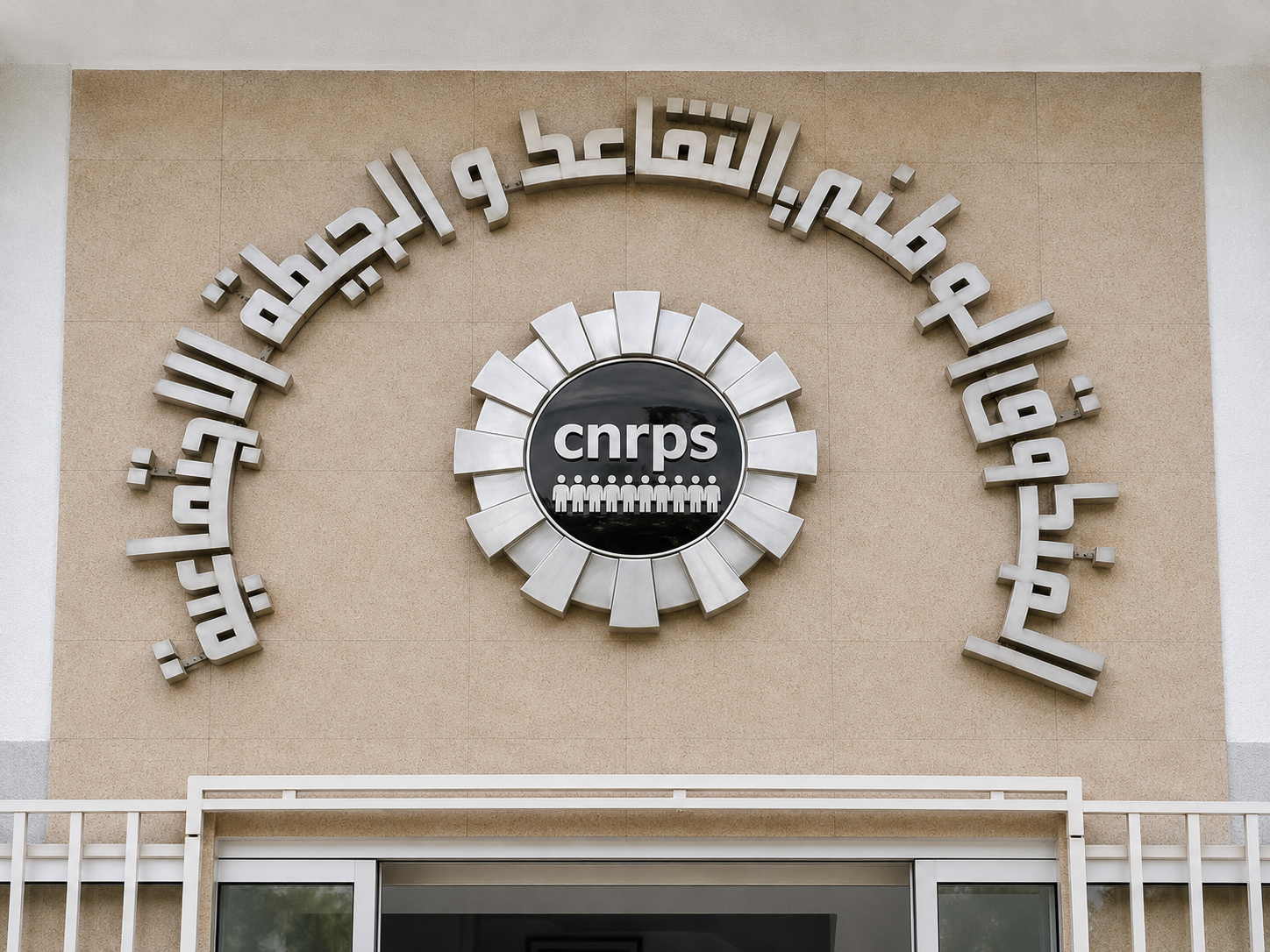
The National Pension and Social Welfare Fund (CNRPS) manages Tunisia’s statutory social security schemes for public-sector employees, including staff working for the State, local authorities, public institutions, and certain public-sector companies.


The modernization project addresses several key challenges:


  • An information system in need of modernization: A rigid architecture limiting scalability, adaptability to evolving requirements, and large-scale security.
  • Complex and sensitive processes: Risk of calculation errors and inconsistencies that could directly affect pensions and beneficiaries’ entitlements.
  • Critical data volumes: More than 1.2 million affiliates, with highly sensitive personal and career-related data to manage and secure.

Solution & Contribution

think tank is supporting the National Pension and Social Welfare Fund (CNRPS) in designing and implementing a new information system dedicated to pension and benefits management, together with an Individual Account Exchange Platform.


The solution is designed to serve more than 1.2 million public-sector affiliates in Tunisia, while strengthening the reliability, security, and efficiency of pension management processes.

Sector :
E-Government


Beneficiary :

National Pension and Social Welfare Fund (CNRPS)


Funded by :
IBRD – World Bank


Contracting authority:

Ministry of Communication Technologies 

Target scope

  • Pension & benefits liquidation management
  • Contribution statement management
  • Pension review management
  • Objection & opposition management
  • Remote control management
  • Campaign management
  • Pension suspension management
  • Arrears & back-payment management

Expected results

  • Faster pension processing: Reduced processing times and backlog, enabling pensions to be paid more quickly.
  • Enhanced protection of the rights of +1.2 million affiliates: Automated calculations, harmonized business rules, and reduced risk of errors.
  • Unified Individual Account: A consolidated and reliable view of each affiliate’s career history and social security entitlements.


View all references

Development of the National Business Register Information System (RNE)
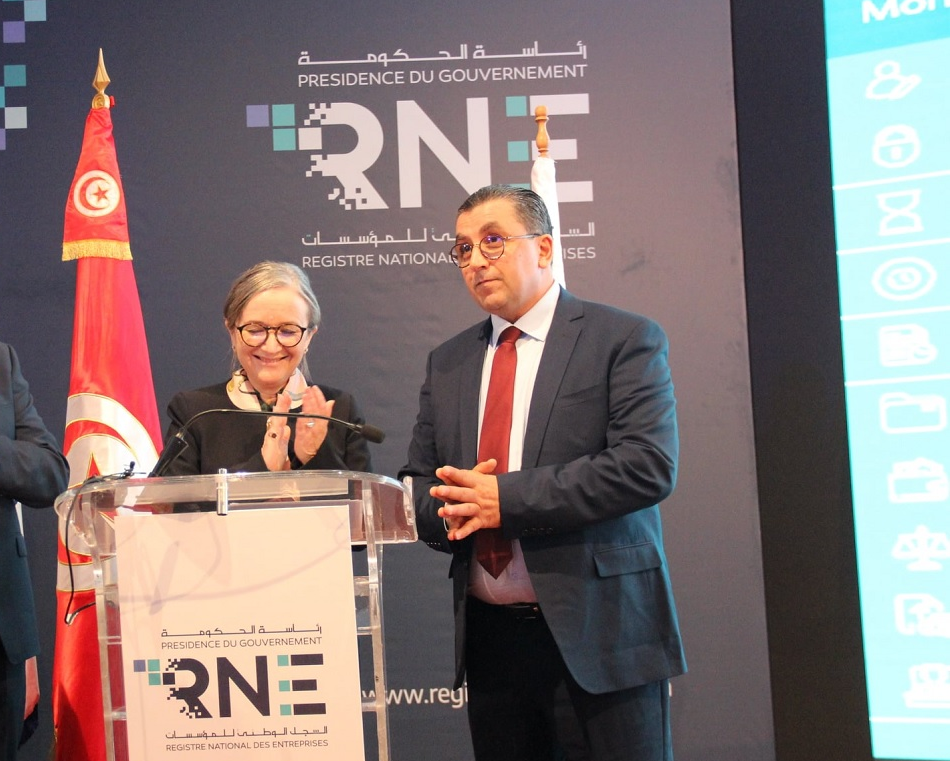
Lancement d'une plateforme électronique pour l'enregistrement des entreprises à distance

Context & Challenges

Since 2018, the National Business Register Center (CNRE) has been responsible for recording and managing metadata related to businesses, companies, organizations, NGOs, liberal professions, and other entities established in Tunisia.


The management of administrative procedures and related data faced several key challenges:


Solution & Contribution

think tank supported the digital transformation of the National Business Register (RNE) through the development, modernization, and ongoing maintenance of its digital platform.

The platform centralizes data related to individuals and legal entities, facilitating its collection, management, and secure access for citizens, businesses, and Tunisian public institutions.

Sector :
E-Government


Beneficiaries :

National Business Register Center (CNRE) 


Funded by :
USAID, GIZ, World Bank


Contracting authority:

USAID, GIZ, World Bank 


Useful links : 

www.registre-entreprises.tn

Key Milestones

🚩 2008: think tank implemented the first information system for the Ministry of Justice and INNORPI, covering the Local and Central Commercial Registers (RCL/RCC).


🚩 2018: Redesign of the legacy information system and launch of the first 100% online commercial register extract at the Tunisia Digital Summit (TDS).


🚩 2019: Opening of the first INNORPI service counter responsible for maintaining the register, followed by the official launch of the RNE.


🚩 2022–2023: Redesign of the RNE platform, introducing new modules and e-services, beneficial ownership management, e-signature, and other digital services.


🚩 2026: Full digitalization of RNE services and procedures, with enhanced security.

Key features 

Results & Impact

In collaboration with our partner think tank Business Solutions, we have successfully designed and implemented, since 2008, one of the most effective and complex information systems within the eGovernment environment: Tunisia’s Commercial Companies Register.

Adel Chouari

General Director, National Business Register Center (CNRE)

Want to learn more?

Contact us.



View all references

DALIL: National Administrative Procedures Platform (PNPA)

Context & Challenges

Launched in June 2020 with financial support from the World Bank, the GovTech Tunisia program aims to improve the accessibility, quality, and accountability of public services, particularly in education, social protection, and administrative reform.


Within this framework, the PNPA project aims to establish and operate the National Register of Administrative Procedures, a reference platform providing citizens and businesses with centralized access to information on administrative procedures.


The project addresses several key challenges:


  • Fragmented information: Administrative procedures were dispersed across different sources, heterogeneous, sometimes undocumented, and occasionally outdated.
  • Complex administrative procedures: Citizens and businesses faced difficulties identifying and understanding the procedures applicable to them.
  • Large-scale harmonization: Aligning +25 ministries and public institutions around a common, regularly updated reference framework.

Solution & Contribution

think tank developed and implemented the National Administrative Procedures Platform (PNPA), a unified portal and centralized reference framework covering administrative procedures from +25 ministries and the Presidency of the Government.

Sector :
E-Government


Beneficiary :

Presidency of the Government – General Directorate for Administrative Reforms and Foresight


Funded by :
BIRD – World Bank 


Contracting authority:

Ministry of Communication Technologies

Key features 

  • Search & consultation of administrative procedures/ forms
  • Procedure classification by ministry, sector, and domain
  • Procedure modification & updates by ministries
  • Procedure validation & publication workflows
  • Management of Citizens/ businesses’ proposals and complaints 
  • KPIs and performance monitoring at national, sectoral, departmental, and procedure levels

Results & Impact

  • Unified national reference framework: +3,000 administrative procedures identified, standardized, and structured.


  • Simpler and more accessible procedures: +70% of procedures simplified and/or digitized, reducing processing times, travel, and administrative burden.


  • Better-equipped public administration: Harmonized practices across administrations and a foundation supporting future digitalization and automation initiatives.

Today, we are celebrating not only the preparation for the launch of a new platform, but also a complementary reform vision that makes public administration an effective tool serving citizens and businesses.

Olfa Souli Ouertani
General Director for Administrative Reforms and Foresight (DGRPA)

Development of a digital platform for auto-entrepreneurs

plateforme autoentrepreneur Tunisie

Context & Challenges

As part of Tunisia’s policies promoting social and economic inclusion, the country introduced the auto-entrepreneur status through Decree-Law No. 2020-33 of June 10, 2020. The status aims to simplify the creation and management of individual businesses through streamlined administrative, tax, and social security procedures.


The initiative seeks to facilitate the formalization of the informal economy and enable nearly 300,000 people to access auto-entrepreneur status across 560 economic activities.


The implementation addresses several key challenges:


  • Formalization of the informal economy: Facilitating the integration of informal economic actors into the legal framework and improving their access to social services.
  • Lack of reliable data: Improving visibility into the size, nature, and geographical distribution of informal activities.
  • Digital accessibility: Designing simple and accessible services for users with limited digital literacy.

Solution & Contribution

think tank developed and implemented the Auto-Entrepreneur Platform, enabling Tunisian auto-entrepreneurs to apply for auto-entrepreneur status using Mobile ID and subsequently declare their turnover online.

interfaces plateforme auto entrepreneur

Sector :
E-Government


Beneficiaries :

National Business Register Center (CNRE) – Ministry of Vocational Training and Employment


Funded by :
USAID


Contracting authority:

DAI Global, LLC 


Useful links : 

www.autoentrepreneur.tn

Key features 

  • Online registration for auto-entrepreneur status via Mobile ID
  • Online turnover declaration
  • Application tracking for auto-entrepreneurs
  • Centralized data management within the National Business Register (RNE)
  • Real-time interoperability with the DGI, CNSS, CNRPS, and ANETI

Results & Impact

  • Formalization of self-employed activities and greater integration of auto-entrepreneurs into the formal economy.
  • Simplified and digitalized procedures: Online registration, turnover declaration, and application tracking, reducing paperwork and the need for in-person visits.
  • Improved access to social protection, including health insurance and occupational accident coverage.
  • Greater efficiency for the RNE through a centralized database and standardized, digitalized procedures.
  • Support for entrepreneurship and economic inclusion by facilitating the launch and development of individual business activities.

The Auto-entrepreneur platform is 100% digital. Its role is to provide minimum social protection to students who want to work, retirees, and even those who already have an income and seek to improve their financial situation.

Adel Chouari

General Director, National Business Register Center (CNRE)

GRB 2.0: Budgetary Resources Management Solution for Local Authorities

ministère intérieur tunisie

Context & Challenges

As part of the REMO program, which focuses on strengthening local governance and modernizing public services in Tunisia, GRB 2.0 (Budgetary Resources Management) aims to modernize the financial management of local authorities and accelerate their digital transformation.


The new version builds on GRB 1.0, whose architecture and operating model presented several limitations:


  • Fragmented data: A separate database for each local authority.
  • Outdated architecture: Client-server architecture and decentralized on-premise infrastructure.
  • Limited interoperability: Restricted data exchanges with other financial systems, resulting in duplicate data entry and reprocessing.
  • Need for a modern and scalable foundation: To support the digitalization of local authorities and the integration of new services.

Solution & Contribution

think tank developed and implemented GRB 2.0, a solution dedicated to managing the financial resources of Tunisian local authorities.

The solution covers the entire revenue management lifecycle, from revenue assessment and recording to collection and recovery, while enhancing efficiency, transparency, and traceability.

Sector :
E-Government 


Beneficiary :

Ministry of the Interior (Local Affairs)


Funded by :
GIZ


Contracting authority:

GIZ

Key features 

  • Local taxation: Assessment and management of local taxes (TIB, TNB, TCL, TH).
  • Taxpayer management: Tracking of taxpayer records, statuses, and obligations.
  • Revenue & collection management: Receipts, bulk payments, fees, and other revenue.
  • Fines & penalties: Management of notices, issuance, tracking, and payment.
  • Revenue recovery: Reminders, notices, penalties, outstanding payments, etc.
  • Assets & contracts: Management of contracts, concessions, leases, sales, and agreements.
  • Financial oversight: Collection history, off-budget transactions, and state transfers.
Solution de Gestion des Ressources Budgétaires pour les Collectivités Locales

Results & Impact

  • Unified budgetary reference framework: A centralized source of reference providing greater visibility into local finances.
  • Optimized revenue collection: Improved monitoring and management of municipal taxes and fees.
  • Greater financial transparency: Enhanced traceability of financial operations and reliable data for oversight bodies.
  • Enhanced interoperability: Automated data exchanges with public information systems, including the National Unique Citizen Identification System and the National Business Register (RNE).
  • +2,000 users covered: Including municipal staff, revenue officers, and public accountants.

MSA IDARTI : Platform for Municipal Administrative Service Centers

MSA IDARTI

Context & Challenges

As part of the “Support for Decentralization and Strengthening of Local Finances in Tunisia (ADEC II)” project, the initiative aims to strengthen municipalities’ capacity to provide more efficient, transparent, and accessible local administrative services to citizens.


Covering 7 governorates and 21 municipalities across northwestern and west-central Tunisia, the project introduces a new model for Municipal Administrative Service Centers (MSAs), directly managed by municipalities.


The main challenges include:


  • Public service integration: Connecting multiple service providers and national information systems despite technical, compatibility, and synchronization challenges.
  • Adoption of the new model: Supporting municipalities in adopting the solution and managing organizational change.
  • Harmonization of practices: Ensuring a consistent service experience and standardized quality levels across municipalities.
  • Territorial & financial inclusion: Bringing administrative services closer to rural populations and facilitating access to payment services for unbanked citizens.

Solution & Contribution

think tank developed and deployed the MSA- Idarti platform, enabling Tunisian municipalities to provide a centralized catalog of administrative services that were previously delivered by other service providers, including social security institutions, the Tunisian Company of Electricity and Gas (STEG), SONEDE, and others.

MSA IDARTI

Sector :
E-Government 


Beneficiary :

Presidency of the Government – General Directorate for Administrative Reforms and Foresight


Funded by :
GIZ


Contracting authority:

GIZ


Useful links : 

www.msa-idarti.gov.tn

Key features 

  • Integration with IT systems of key public service providers (e.g., CNSS, telecom, health insurance) via API Gateway
  • Public service management by national provider
  • Citizen request tracking & history
  • E-payment of social security contributions and utility bills (electricity, water, etc.)
  • Integration of local electronic payment solutions (e-wallets, etc.)
  • Online processing of administrative procedures, complaints & suggestions

Results & Impact

  • +25 public services available online, simplifying citizens’ administrative procedures.
  • Nearly 1 million beneficiaries, with improved access to local administrative services.
  • +6 national institutions interconnected: STEG, SONEDE, CNSS, CNRPS, CNAM, and Tunisie Telecom.
  • Greater municipal autonomy, enabling municipalities to respond more directly and efficiently to citizens’ needs.
  • More accessible and secure services, through centralized procedures and integrated electronic payment solutions.
  • Improved citizen satisfaction with local authorities.

SIADE: Information System for External Debt Administration

Ministère-des-finances

Context & Challenges

Public debt management is a major challenge for Tunisia’s economic and financial stability. In a constantly evolving economic environment, public decision-makers need a reliable, consolidated view of debt to support informed decisions, anticipate developments, and optimize debt management.


Against this backdrop, FAST (Fiscal and Accounting System of Tunisia) launched a project to develop a decision-support platform for public debt management, providing decision-makers with the tools needed to analyze, anticipate, and effectively manage debt.


The project addressed several key challenges:


  • Limited process digitalization: Manual processing of certain requests and agreements.
  • Long processing times: Lengthy and inefficient loan request management processes.
  • Fragmented systems: Coexistence of heterogeneous systems with limited interoperability.
  • Scattered data: Lack of a centralized and consolidated view of debt-related information.

Solution & Contribution

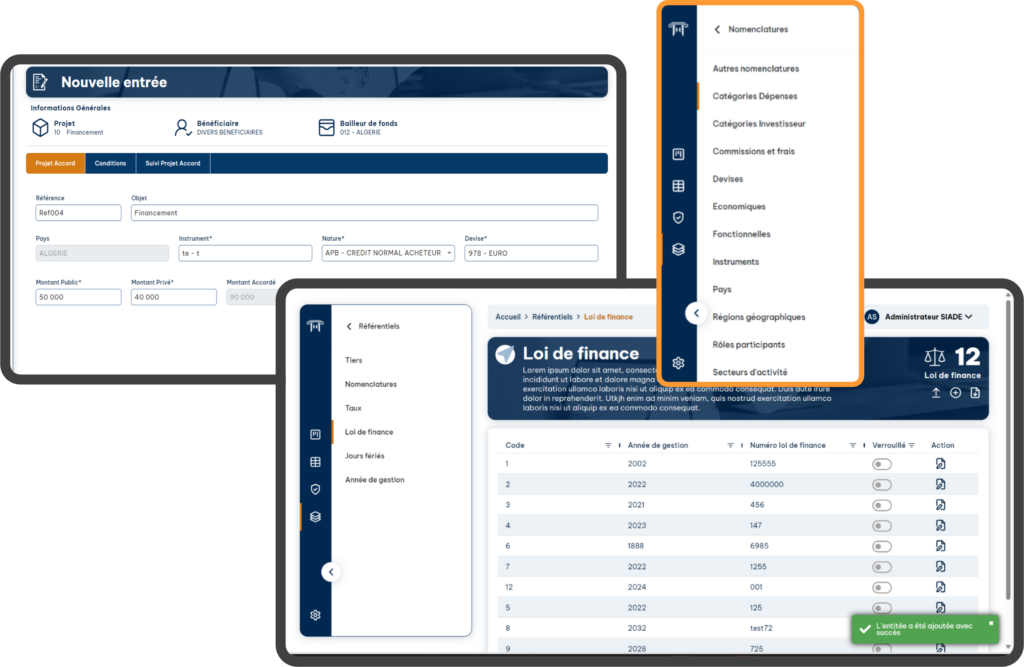
think tank supported the development of the Information System for External Debt Administration (SIADE), dedicated to managing Tunisia’s public and private debt. As a central debt management system, SIADE enables relevant teams to record, monitor, and secure the entire lifecycle of debt operations, from loan requests and financing agreements through to final repayment.

SIADE : Système Informatique pour l'Administration de la Dette Extérieure

Sector :
Finance


Beneficiary :

Ministry of Finance of Tunisia 


Funded by :
USAID – FAST 


Contracting authority:

DAI Global, LLC

Key features 

  • Reference data management: Third-party records, classifications, exchange rates, etc.
  • Debt & grants management
  • External resource mobilization
  • Domestic resource mobilization: Loans, Treasury bills, etc.
  • Debt restructuring & agreement renegotiation
  • Guarantees & commitments management
  • Accounting interface management: Classifications, transactions, CRO/CRI

Results & Impact

  • +$1 billion in debt managed through the SIADE system.
  • Faster processes through the digitalization and automation of Ministry workflows.
  • 24/7 access to debt management data and functionalities.
  • Greater transparency and traceability of public and external debt operations.
  • Enhanced decision-making through real-time monitoring of loan agreements, disbursements, and repayments, combined with scenario analysis.

The commitment of the entire think tank team to collaboration and cooperation made the successful redevelopment of the SIADE system possible.

Salah Meddeb
General Director, IT Center of the Ministry of Finance

TIMA : Platform for Tunisian Intelligent Manufacturing Assessment I4.0

Context & Challenges

As part of the national “Towards Industry 4.0 in Tunisia” initiative, led by the Ministry of Industry, Mines and Energy, with the support of the European Union and the Invest for Jobs initiative, and implemented by GIZ Tunisia, the project aims to accelerate the modernization of Tunisian industry through innovation, technology adoption, and the transition to Industry 4.0.


However, the transformation of the industrial sector remains characterized by varying levels of maturity and technology adoption, making it challenging to assess progress at national level.


The key challenges included:


  • Uneven maturity levels: Significant differences in Industry 4.0 adoption across companies and sectors.
  • Limited visibility: Lack of a consolidated view of the digital maturity of Tunisia’s industrial sector and ongoing Industry 4.0 initiatives.
  • Limited awareness: Uneven understanding of Industry 4.0 technologies, benefits, and challenges, particularly among SMEs.
  • Limited decision-making data: Lack of reliable indicators to guide public policies, target investments, and monitor progress.

Solution & contribution

think tank developed TIMA (Tunisian Intelligent Manufacturing Assessment), a digital tool for assessing and monitoring Industry 4.0 maturity.

The platform enables Tunisian manufacturers to assess their level of readiness and adoption of Industry 4.0 principles, technologies, and practices, helping them better define and prioritize their digital transformation plans.

TIMA : Outil digitalisé de recensement des besoins des industriels en I4.0

Sector :
Industry


Beneficiary :

Ministry of Industry, Mines and Energy (MIME) / Agency for the Promotion of Industry and Innovation


Funded by :
GIZ


Contracting authority:
GIZ

Key Features

  • Industry 4.0 assessment & diagnosis: Online assessment questionnaires.
  • Scoring & benchmarking: Calculation of Industry 4.0 maturity scores and sector-based benchmarking.
  • Reporting: Score comparisons, gap analysis, and targeted recommendations.
  • Decision-making dashboards & KPIs: National and sector-specific insights.
  • Periodic reassessment: Regular monitoring of manufacturing companies’ Industry 4.0 maturity.

Results & impact

  • National Industry 4.0 maturity mapping: A comprehensive and up-to-date view of the digital transformation maturity of Tunisian manufacturers.
  • +200 industries assessed and mapped, contributing to a better understanding of Tunisia’s industrial landscape.
  • Decision-support tool: Structured self-assessment tailored to the specific context of Tunisian industry.
  • Support for greater adoption of Industry 4.0 technologies, including robotics, IoT, AI, and cybersecurity.
  • 5 beneficiary Competence Centers located across Tunisia: Novation 4.0 Center – Sousse / Sfax Industry 4.0 Center / Agrotech 4.0 – Bizerte / Biotech 4.0 – Sidi Thabet / Neotex 4.0 – Monastir

Development of a Website for the African Continental Free Trade Area (AfCFTA)

Context & Challenges

On behalf of the German Federal Ministry for Economic Cooperation and Development (BMZ) and co-financed by the European Union, GIZ implements a support program for the African Union (AU) to facilitate trade negotiations and support the implementation of the African Continental Free Trade Area (AfCFTA).


The program also operates at national level in 10 partner countries, including Tunisia, to support AfCFTA implementation and strengthen the involvement of SMEs and civil society through information sharing and awareness-raising.


A key challenge is to make the progress, opportunities, and potential impact of AfCFTA more visible and accessible, helping stakeholders better understand the process and encouraging their active participation.

Solution & contribution

think tank developed and maintains a multilingual, scalable website for the African Continental Free Trade Area (AfCFTA), designed to showcase AfCFTA activities, policies, and initiatives while increasing its visibility among African and international economic stakeholders.

Sector :
E-Government


Beneficiaries :

German Federal Ministry for Economic Cooperation and Development (BMZ) for the African Union (AU)


Funded by :
GIZ


Contracting authority:
GIZ

Key Features

  • AfCFTA information portal providing centralized access to key information.
  • Interactive map: Explore African countries and markets.
  • Document library & resources: Studies, publications, regulatory documents, and other resources.
  • News & events: Calendar of AfCFTA-related events and initiatives.
  • Success stories: Showcasing businesses and real-world experiences of intra-African trade.

Results & impact

  • Improved access to economic opportunities: SMEs, entrepreneurs, and economic stakeholders benefit from centralized information on markets, trade opportunities, and financing mechanisms.
  • Greater visibility for intra-African trade: Easier access to information on African markets and AfCFTA mechanisms helps stakeholders identify opportunities and navigate trade barriers.
  • A more connected economic ecosystem: The platform facilitates information sharing and promotes initiatives that support regional cooperation.
  • Support for inclusive growth: Broader access to economic information contributes to an enabling environment for entrepreneurship, investment, and job creation.

Development of an AI-Powered Technology Intelligence Platform: R2T2

Context & Challenges

Since the 2000s, Tunisia has faced a growing energy deficit. In response, the Tunisian government has adopted an energy transition strategy aimed, among other objectives, at reducing primary energy demand by 30%.


As part of the “Support for an Accelerated Tunisian Energy Transition (TETA)” project, the Ministry of Industry, Mines and Energy (MIME), the National Agency for Energy Management (ANME), and the Tunisian Company of Electricity and Gas (STEG), in cooperation with GIZ, sought to develop a technology intelligence platform to support Tunisia’s energy transition.

Solution & contribution

think tank developed Renewables Radar & Transition Technology (R2T2), an AI-powered technology intelligence platform providing a shared knowledge base on trends, innovations, and resources related to renewable energy.

Sector :
Energy


Beneficiaries :

Ministry of Industry, Mines and Energy (MIME), the National Agency for Energy Management (ANME), and the Tunisian Company of Electricity and Gas (STEG)


Funded by :
GIZ


Contracting authority:
GIZ

Key Features

  • Smart search: Simple and advanced queries, with keyword suggestions.
  • Knowledge management: Classification, tagging, annotation, and document import.
  • Multi-source monitoring: Websites, newsletters, patents, RSS feeds, and other sources.
  • AI-assisted semantic analysis: Automated summaries and content clustering.
  • Collaboration and validation workflows: Shared projects, comments, and collaborative review.
  • Analytics & KPIs: Most-viewed sources and content, recurring visitors, and other usage indicators.

Results & impact

  • Improved access to energy-related information and more efficient research capabilities.
  • Enhanced technology intelligence through AI, enabling stakeholders to track industry trends and the latest developments.
  • Stronger collaboration and knowledge sharing among researchers and experts.
  • Greater visibility and promotion of renewable energy, supporting Tunisia’s energy transition.
  • A connected ecosystem of energy-transition stakeholders, facilitating information sharing between ministries (including MIME), STEG, ANME, renewable energy project developers, consulting firms, universities, research institutions, and financial institutions.